
Container Gardens
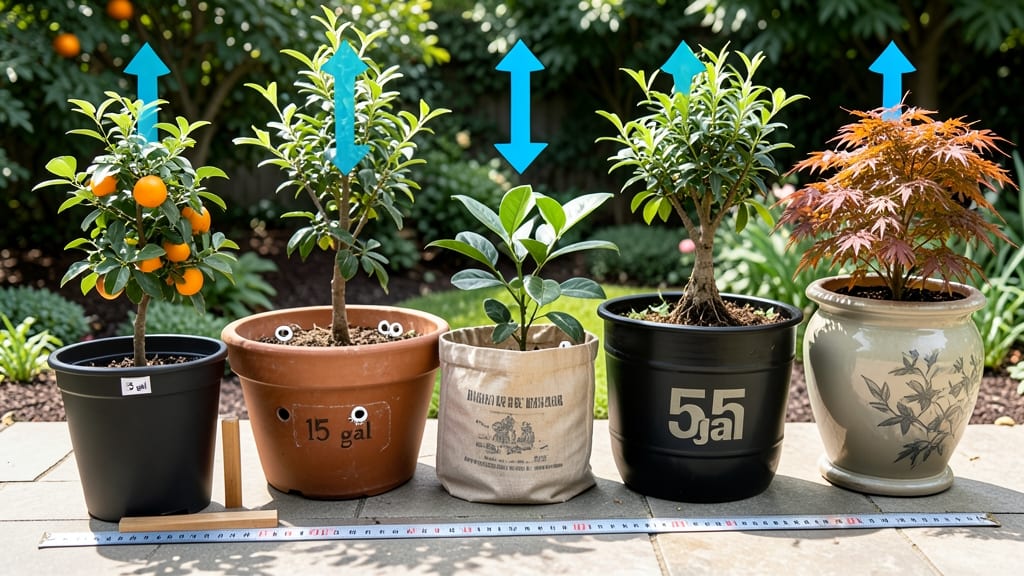
A tree container size chart matches pot dimensions to tree maturity for healthy root development: use 5-gallon containers for young saplings, 15-gallon pots for small trees, and 30+ gallons for mature specimens, ensuring depth exceeds root ball height by 25%. Always prioritize drainage holes and sturdy bases for stability.
A properly sized container prevents root binding and nutrient depletion by giving roots space to expand. 🌳 For instance, a 15-gallon pot might seem adequate for a 3-foot tree, but if you're growing a fast-growing species like a crepe myrtle, you'll need to upgrade to 25+ gallons within 2-3 years.
The key is anticipating growth—most trees double in size every 5-7 years, so plan ahead with containers that can accommodate this expansion without frequent repotting. Fabric grow bags offer flexibility but require more frequent watering, while heavy ceramic pots provide stability for wind-prone areas.
Container material also affects sizing needs. Plastic pots retain moisture longer, allowing for slightly smaller volume calculations, while wood and ceramic require more generous dimensions to prevent overheating or cracking.
Always verify weight limits—mature trees in 30-gallon containers can weigh 100+ pounds when saturated, so ensure your patio or balcony can support the load. The right container isn't just about size; it's about creating an environment where roots can thrive without stress.
💡 In This Article
- How Root Ball Size Determines Container Dimensions
- Best Container Materials and Sizing for Different Tree Types
How root ball size determines container dimensions
The relationship between root ball size and container volume follows a precise formula rooted in horticultural science. Trees need space for roots to spread horizontally and vertically—typically, a container should provide 25-30% more volume than the root ball's current size.
For example, a 1-gallon sapling's root ball occupies roughly 0.03 cubic feet, but its container should hold at least 1.5 gallons to allow growth. This extra space prevents root circling, where roots grow in tight loops around the container's edge, restricting nutrient uptake and stunting growth.
Depth is often more critical than width because roots grow downward first to access deeper moisture and nutrients. A container's depth should exceed the root ball's height by at least 25%—for a 12-inch-tall root ball, that means a 15-inch-deep pot.
Shallow containers force roots to grow horizontally, increasing the risk of drought stress and toppling in wind. Fast-growing species like willows or silver maples need even more depth, as their roots can extend 3-5 feet deep within 5 years.
Slow growers like Japanese maples require less volume but still need 10-15% extra space for stability.
Soil volume directly impacts nutrient absorption and moisture retention. A 15-gallon container holds about 1.8 cubic feet of soil, enough for a 3-4 foot tree but insufficient for a 5-foot crepe myrtle within 2 years.
The rule of thumb: multiply the tree's mature height (in feet) by 0.5 gallons to estimate minimum container size. For instance, a 10-foot mature tree needs at least a 5-gallon container at planting but should graduate to 30+ gallons within a decade.
Overcrowded roots trigger stress hormones like ethylene, which stunts growth and weakens the tree's immune response.
Container stability becomes a factor as trees mature. A 30-gallon pot filled with saturated soil can weigh 100+ pounds, requiring a sturdy base or anchoring system. Wind exposure amplifies this risk—trees with root balls wider than 12 inches need containers with weighted bases or sandbags to prevent tipping.
The deeper the roots, the more stable the tree, which is why fabric grow bags (though flexible) often need 10-20% larger volume than rigid containers to compensate for their shallower depth.
Seasonal adjustments also play a role. In winter, roots slow their growth, reducing the urgency for larger containers, but spring's rapid growth demands immediate upgrades.
For example, a 2-year-old apple tree in a 7-gallon pot might need a 15-gallon upgrade by early spring to support its 3-foot height and 1-inch-thick trunk.
The goal is to mimic natural soil conditions—roots in the ground spread 2-3 times wider than the tree's canopy, so containers should replicate this ratio as closely as possible.
Here's what happens when sizing is off: undersized containers cause root binding (roots growing in circles), while oversized ones lead to excessive moisture retention and fungal diseases.
The sweet spot balances growth potential with practicality—always leave 2-3 inches of space between the root ball and container edges to allow root expansion without stress.