
Plants
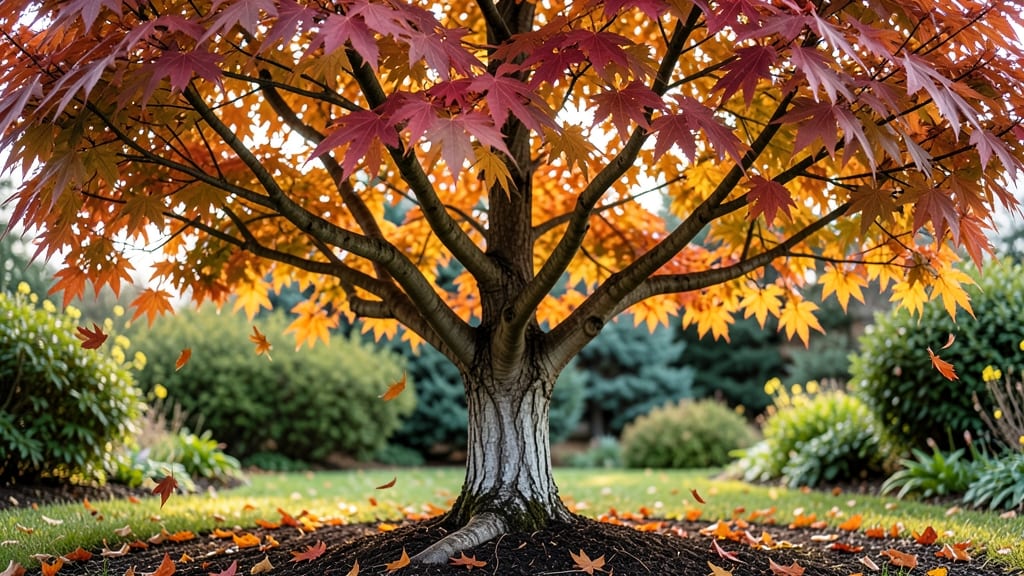
A maple tree looks like a stately tree with lobed leaves (3-9 pointed sections), smooth gray bark that develops ridges as it ages, and a wide, rounded crown. These trees grow between 40 to 80 feet tall, though some varieties like the sugar maple can exceed 100 feet at maturity, and their brilliant autumn colors make them stand out in any landscape.
A maple tree's most recognizable feature is its palmate leaves, which spread out like fingers from a central point. 🌿 The bark starts smooth and silvery-gray but develops deep furrows as the tree matures, creating a textured appearance that's easy to identify.
What really sets them apart is their seasonal transformation—sugar maples turn fiery red, while red maples often display a mix of orange and purple hues. These visual traits make them a favorite for both urban and rural landscapes, where they provide year-round interest.
Young maple trees are often overlooked because their bark remains smooth and their leaves are smaller, but their unique branching pattern (often with a V-shaped crotch) is a dead giveaway. 🌳 As they grow, their height and leaf size become more pronounced, helping them dominate the landscape.
Whether you're identifying one in a park or choosing a tree for your yard, these distinct features make maple trees unmistakable.
💡 In This Article
- Identifying Maple Tree Species by Leaf and Bark Characteristics
- How to Spot Young vs Mature Maple Trees in Landscapes
Identifying maple tree species by leaf and bark characteristics
The most reliable way to distinguish maple species starts with their leaves. Sugar maples have 5 lobes with sharp, serrated edges, while red maples typically feature 3-5 lobes with more rounded tips.
Silver maples stand out with 5-7 lobes that appear almost silvery-green due to fine hairs on the undersides, while boxelder maples have 3-5 lobes that resemble ash leaves but with a more angular shape. 🍁 Japanese maples take this further with deeply dissected leaves that resemble lace, and Norway maples have 5 lobes with a distinct "U" shape at the base of each lobe.
Bark provides another key identifier. Young maples of all species have smooth, silvery-gray bark, but as they mature, the differences become clear. Sugar maples develop deep, interlacing ridges that create a blocky appearance, while red maples form shallow, scaly plates that resemble alligator skin.
Silver maples maintain smoother bark longer but eventually develop broad, shallow furrows, while boxelder bark stays relatively smooth with only faint ridges.
The progression from smooth to textured bark happens gradually—sugar maples typically show significant ridging by 30-40 years, while red maples develop their distinctive pattern by 20-30 years.
Seasonal color changes offer additional clues. Sugar maples are famous for their vibrant red foliage in autumn, while red maples often display orange and purple hues simultaneously on the same tree. Silver maples turn golden-yellow, and boxelder leaves shift to yellow-brown.
Japanese maples provide a dramatic contrast with foliage ranging from deep purple to fiery orange, depending on the cultivar.
These color variations occur because different species produce varying levels of anthocyanins (pigments) in response to temperature drops—sugar maples, for example, contain up to 30% more anthocyanins than red maples, which is why their colors appear more intense.
For those who enjoy hands-on identification, the leaf arrangement also matters. Maple leaves grow in opposite pairs along the stem, unlike many other trees where leaves alternate. This "opposite branching" pattern is visible even in young saplings and remains consistent throughout the tree's life.
The petiole (leaf stalk) is another distinguishing feature—sugar maples have a winged petiole that looks like a miniature leaf, while other species have smooth stalks. This anatomical detail becomes especially useful when identifying trees in winter when leaves are absent.
Don't overlook the tree's overall growth habit. Sugar maples develop a pyramidal shape when young that broadens into a rounded canopy, while red maples maintain a more oval shape throughout their lives. Silver maples grow much faster, often developing a wide, irregular crown with branches spreading at wide angles.
These structural differences reflect how each species adapts to its environment—sugar maples thrive in cooler climates with dense canopies, while silver maples grow rapidly in wetter conditions where their broad branches help them capture sunlight.