
Pruning
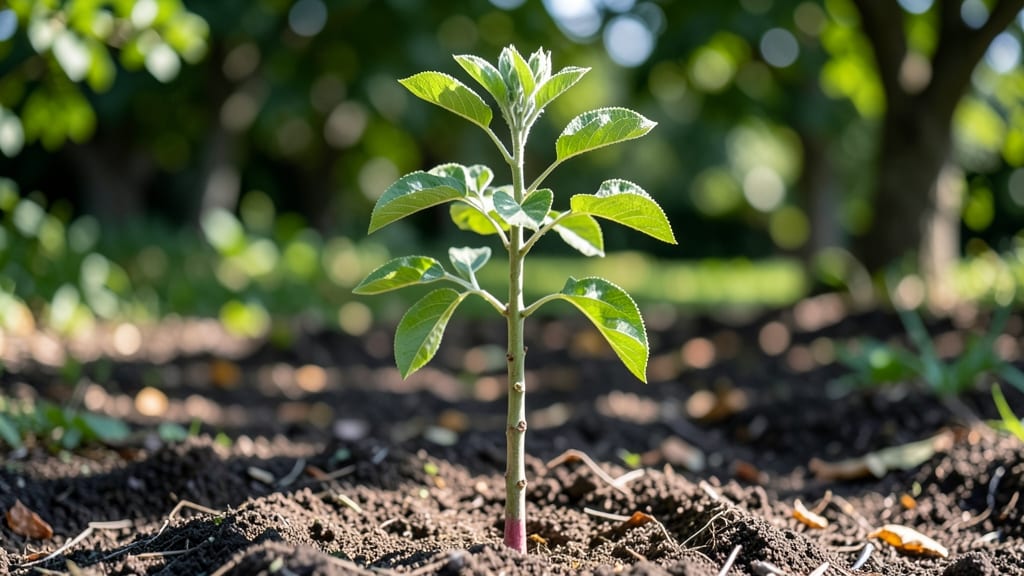
The identification of an apple tree seedling starts with one simple question: is it destined to reach 30 feet or stay compact? 🌱 The difference between dwarf and standard varieties shows up in the first year—leaf shape, shoot growth, and even how the buds cluster along the branch.
I’ve spent years comparing seedlings side by side, and these visual clues save beginners from years of confusion (and pruning regrets).
Dwarf varieties reveal themselves early with smaller leaves—typically 2-3 inches long—and a more upright, bushy growth habit. Standard seedlings sprawl wider, with leaves closer to 3-4 inches, and their bark stays smoother longer.
Crabapples? Look for serrated edges and a wild, tangled growth pattern—nothing like the neat, predictable structure of true apple seedlings.
By summer’s end, you’ll spot the real giveaway: how the branches angle. Dwarf seedlings grow at 45-degree angles or steeper, while standard varieties spread out horizontally. Even the buds differ—dwarf buds sit closer together, like a tightly packed row of tiny green beads, while standard buds space out more loosely.
This isn’t just about size—it’s about planning. A misidentified seedling could mean years of wasted space or a fruit tree that outgrows its spot. Grab a notebook, a ruler, and a magnifying glass (yes, really), and you’ll nail this every time. Let’s break it down step by step.
Root Causes Of Misidentification
Understanding why apple tree seedlings can be tricky to identify starts with recognizing the biological and environmental factors at play. Here’s a breakdown of the key reasons, explained in scientific terms with actionable insights:
---
Apple trees grown from seeds (rather than grafts) are not true to type, meaning they won’t reproduce the exact traits of the parent tree. This happens because: - Cross-pollination: Apple trees are often cross-pollinated by bees or wind, blending genetic material from multiple trees.
A seedling from a "Granny Smith" apple might sprout into a completely different variety with unknown disease resistance, fruit size, or growth habit. - Heterozygosity: Apple trees are highly heterozygous (genetically diverse), so seedlings inherit a random mix of traits from both parents.
This makes predicting dwarf vs. standard growth patterns nearly impossible. - Juvenile phase: Seedlings enter a juvenile phase (lasting 3–10 years), where they focus on root and leaf growth instead of flowering or fruiting. During this time, their true mature size and shape remain hidden.
Actionable tip: 💡 If you’re relying on seed-grown seedlings for orchard planting, expect 90%+ failure in matching the desired variety. Grafting (discussed later) is the only reliable method for consistent identification.
---
Seedlings don’t grow in a lab—they’re shaped by their surroundings. Environmental factors can mimic or mask dwarf vs. standard traits: - Soil nutrients: Poor soil (low nitrogen, phosphorus, or potassium) stunts growth, making a standard variety appear dwarf-like.
Conversely, rich compost or fertilizer can accelerate a dwarf’s growth, blurring size distinctions. - Water availability: Drought stress slows root development, while overwatering can lead to leggy, weak stems.
Both conditions distort natural growth patterns. - Light exposure: Seedlings in shade (e.g., under a larger tree) grow taller and thinner to reach sunlight, while those in full sun develop stockier trunks. This can make identification based on habit alone unreliable.
Pro move: 🌡️ Test soil pH and nutrient levels (use a DIY kit or lab analysis) to rule out environmental stunting. Move seedlings to a controlled environment (e.g., a nursery bed) for 6–12 months to observe their true growth trajectory.
---
Even experienced growers mix up seedlings because dwarf and standard apple trees share overlapping characteristics in their early stages: | Trait | Dwarf Varieties | Standard Varieties | Why It’s Tricky | |--------------------------|---------------------------------------------|--------------------------------------------|---------------------------------------------| | Trunk thickness | Thin (0.5–1.5 inches at maturity) | Thick (2+ inches at maturity) | Seedlings rarely exceed 0.5 inches in their first year. | | Leaf size | Smaller (2–4 inches long) | Larger (4–6 inches long) | Environmental stress shrinks all leaves. | | Branching angle | Upright, compact | Wider, sprawling | Pruning or wind can alter angles in seedlings. | | Growth rate | 1–2 feet/year (mature) | 2–4 feet/year (mature) | Seedlings may grow erratically in their first year. |
Key insight: 🎯 No single trait guarantees identification—combine observations over time (e.g., trunk thickness and leaf size and branching pattern) for accuracy.
--- One of the biggest red flags in seedling identification is the absence of flowers or fruit, which are critical for confirming variety: - Delayed maturity: Apple seedlings may take 5–10 years to flower, leaving you guessing about their potential size or fruit type. - Environmental triggers: Cold winters or insufficient chilling hours (measured in chill units) can prevent flowering entirely, even in mature trees. - Pollination dependence: Some varieties require a compatible pollinator.
A seedling might never fruit if no other apple tree is nearby.
Workaround: ✨ If you’re desperate for clues, check for bud scars (horizontal lines on branches) or leaf shape (e.g., serrated edges vs. lobed). However, these are not foolproof—consult a local extension office for DNA testing if precision matters.
--- Not all apple tree seedlings are created equal—how they’re grown affects identification: - Seed vs. cutting vs. graft: Seedlings from pits are wildcards, while cuttings or grafts from a known variety (e.g., "Columnar" or "Semi-Dwarf") will inherit predictable traits.
Mislabeling propagation methods leads to confusion. - Rootstock influence: Even grafted trees can be misidentified if the rootstock (e.g., M.9 for dwarfing) isn’t documented.
A standard scion grafted onto a dwarf rootstock will still grow small—but without records, you won’t know. - Age at transplanting: Seedlings moved too early (before 1–2 years old) may struggle to establish, stunting their growth and making them look dwarf-like by default.
Critical step: 📝 Label everything—include the parent variety, propagation date, and rootstock type if applicable. Use stakes or plant tags with UV-resistant markers.
Fixing Your Seedling’s Confusion
Identifying whether your apple tree seedling will grow into a dwarf or standard variety can feel like solving a puzzle—especially if you’re working with an unknown parent tree. But don’t worry! With the right approach, you can correct misidentifications, adjust expectations, and even optimize growth for your desired outcome.
Below are practical solutions tailored to common causes of confusion, along with prevention tips to avoid future headaches.
---
If you assumed the seed came from a dwarf variety but the parent tree was actually standard-sized, you’re in for a surprise—seedlings from standard trees will grow tall unless grafted.
#### How to Fix It: 🔥 Test the Seedling Early - 👨🍳 Observe Growth Rate: Standard apple tree seedlings can grow 6–12 feet in 5–10 years, while dwarf varieties max out at 6–8 feet (even with pruning).
Measure height annually—if it’s shooting up faster than expected, it’s likely standard. - 🔍 Check Leaf Shape & Size: Dwarf varieties (like ‘Columnar’ or ‘Semi-Dwarf’) often have smaller, denser leaves compared to standard trees. Compare with known dwarf cultivars.
💡 Pro Tip: If you’re unsure, root graft the seedling onto a dwarfing rootstock (like M.9 or B.9) to control its size. This is a common practice in commercial orchards!
#### Prevention Tips: ✅ Buy Certified Dwarf Scions: If you’re planting from seed, avoid relying on parent tree assumptions—instead, purchase grafted dwarf seedlings from reputable nurseries. ✅ Label Your Trees: Keep a growth log with measurements and photos to track progress.
---
If your seedling was supposed to be grafted onto a dwarfing rootstock but failed, it may grow unpredictably.
#### How to Fix It: 🔪 Inspect the Graft Union - 🔍 Look for a Swollen Area: A successful graft will have a visible bump or scar where the scion (top variety) meets the rootstock.
If it’s smooth or missing, the graft may have failed. - 🌿 Check Root Growth: Dig carefully around the base—if roots look thick and vigorous (like a standard tree), the rootstock may have taken over.
💡 Pro Tip: If the graft failed, re-graft the seedling onto a dwarf rootstock while it’s still young. Use compatible rootstocks (e.g., M.9 for apples) and clean tools to prevent disease.
#### Prevention Tips: ✅ Buy from Trusted Nurseries: Reputable sellers certify their grafts—ask for proof before purchasing. ✅ Monitor New Growth: If the tree suddenly grows too fast, investigate the graft union immediately.
---
Pruning can accelerate or stunt growth, making it hard to tell if a seedling is naturally dwarf or just poorly managed.
#### How to Fix It: ⏰ Adjust Pruning Practices - 🌿 For Over-Pruned Trees (Stunted Growth): - 🍳 Reduce Aggressive Cuts: Avoid topping (cutting back to a stub)—instead, prune selectively to encourage balanced growth. - 💪 Fertilize Lightly: Use a low-nitrogen fertilizer to prevent rapid, weak growth. - 🌳 For Under-Pruned Trees (Wild Growth): - 🔪 Prune in Late Winter: Remove suckers and water sprouts to redirect energy to the main structure. - 🎯 Train the Leader: Guide the central stem upward to maintain a strong, upright form.
💡 Pro Tip: Dwarf trees need less pruning than standard ones—over-pruning can stress them into growing taller!
#### Prevention Tips: ✅ Follow Pruning Guidelines: Dwarf trees should be pruned lighter (20–30% of growth removed), while standard trees can handle 30–40%. ✅ Prune at the Right Time: Late winter/early spring (before buds swell) is ideal for apples.
---
Poor growing conditions can mimic dwarf traits (slow growth) or mask standard traits (weak, leggy growth).
#### How to Fix It: 🌿 Optimize Growing Conditions - 💧 Water Consistently: Drought stress makes trees stunted, while overwatering causes weak, tall growth. - ☀️ Ensure Full Sun: Apple trees need 6–8 hours of sunlight daily—shade can make them grow tall and spindly. - 📊 Test Soil pH: Apples prefer slightly acidic soil (6.0–6.5).
Amend with compost or sulfur if needed.
💡 Pro Tip: If your seedling is leaning or weak, it may not be a dwarf variety—it could just be stressed. Adjust care and reassess in a year.
#### Prevention Tips: ✅ Mulch Properly: Use 2–3 inches of organic mulch to retain moisture and regulate soil temp. ✅ Avoid Compacted Soil: Loosen soil around the base annually to improve root health.
--- If you’re still unsure whether your seedling will stay dwarf, grafting onto a known rootstock is the most reliable fix. It’s a one-time solution that guarantees size control—worth the effort for long-term success!
Would you like a step-by-step grafting guide for apple seedlings? Let us know in the comments! 🍏✨
Frequently asked questions
How can I tell if my apple tree seedling is from a crabapple instead of a true apple?
Look for these key differences: crabapples have smaller, rounder leaves (usually 1-2 inches long) with sharp, saw-tooth edges, while true apple seedlings have larger, oval leaves (2-4 inches) with smoother edges. Crabapple branches also grow at wilder angles and produce tiny, tart fruit early—often by year 3—whereas true apple seedlings rarely fruit before age 5.
Why does my seedling have such small leaves? Is it definitely a dwarf variety?
Small leaves (2-3 inches) can indicate a dwarf variety, but they’re also common in stressed seedlings due to poor soil, shade, or drought. Measure the leaf size over time—if they stay consistently small (2 inches) and the tree grows slowly and upright, it’s likely dwarf. Compare with known varieties or consult a local extension office for confirmation.
Can I use leaf shape alone to identify the apple variety?
No, leaf shape varies too much between varieties and is not reliable for precise identification. While some varieties (like 'Granny Smith') have distinctive leaves, most apple seedlings share similar oval shapes. Focus instead on growth habit, bark texture, and branching angles—these traits are more consistent early on. For exact variety ID, consider sending a leaf sample to a lab or using a DNA testing kit.
What should I do if my seedling looks like a dwarf but keeps growing taller?
This could mean it’s a standard variety or simply reacting to rich soil/fertilizer. Monitor its growth for 1-2 years—if it exceeds 3 feet annually, it’s likely standard. To control size, prune aggressively in late winter (remove 30-40% of growth) and switch to a low-nitrogen fertilizer to slow vertical growth.
How do I know if my seedling is healthy enough for accurate identification?
A healthy seedling has vibrant green leaves, no yellowing/browning, and new growth in spring. Check for strong, flexible stems (not brittle) and visible buds along branches. If your seedling shows signs of pests (aphids, mites) or disease (black spots, mold), treat it first—stress alters growth patterns and can make identification unreliable.