
Container Gardens
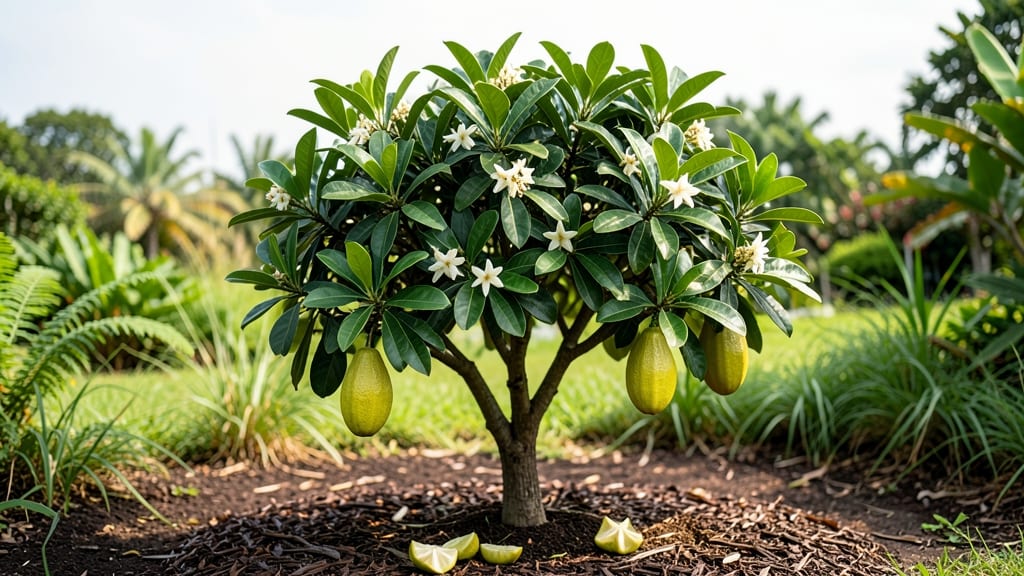
Star fruit trees grow best in USDA Hardiness Zones 10 through 12, where they enjoy warm climates year-round with temperatures consistently above 60°F. These tropical plants cannot survive frost and require full sun exposure to produce optimal fruit yields.
Star fruit trees originate from tropical regions like Southeast Asia and the Caribbean, which explains their strict climate needs. 🌴 Without consistent warmth, their growth slows dramatically, and fruit production suffers. In zones 9 or cooler, gardeners often grow them in containers and bring them indoors during winter months.
The key to success is mimicking their natural tropical environment—think high humidity, protection from wind, and plenty of sunlight. Even a brief dip below 50°F can damage the plant, so planning ahead for winter care is essential.
For container growing, choose large pots with drainage holes and a well-draining soil mix. 🌱 Adding organic matter like compost improves moisture retention while preventing root rot.
When planting outdoors in suitable zones, spring is the ideal time to establish new trees, as the warm months ahead give them time to establish strong root systems before any potential heat stress.
If you're in a marginal zone, consider planting near a south-facing wall or using row covers to extend the growing season.
💡 In This Article
- Understanding Star Fruit Tree Climate Requirements
- Best Planting Months and Container-Growing Tips for Star Fruit Trees
Understanding star fruit tree climate requirements
Star fruit trees, scientifically known as Averrhoa carambola, evolved in tropical climates where temperatures rarely drop below 65°F and humidity stays consistently high.
Their inability to tolerate frost stems from their delicate cellular structure—when exposed to temperatures below 50°F, the plant's cell walls rupture due to ice crystal formation, causing irreversible damage. This sensitivity explains why they thrive exclusively in USDA Zones 10-12, where winter temperatures average between 60-70°F.
The ideal temperature range for star fruit trees spans 75-90°F during the day, with nighttime lows above 65°F.
At these temperatures, the plant's metabolic processes—particularly photosynthesis and fruit development—operate at peak efficiency. 🌞 For example, in Miami (Zone 10B), star fruit trees produce fruit year-round, while in San Diego (Zone 10A), they may experience reduced yields during cooler winter months when temperatures dip near 55°F.
Humidity plays a crucial role too—these trees prefer 60-80% relative humidity to prevent leaf scorch and maintain optimal transpiration rates.
Microclimates can dramatically extend the growing range for star fruit trees in marginal zones. For instance, a south-facing slope or urban heat island effect can raise local temperatures by 5-10°F compared to surrounding areas.
In Zone 9 regions like southern California, gardeners often plant star fruit trees near buildings or against warm walls to create these microclimates. Wind protection is equally important—strong winds dry out the leaves and disrupt pollination, which is critical for fruit production.
What most gardeners don't realize is that star fruit trees have a dormant period during cooler months, even in their native zones. While they don't go fully dormant like deciduous trees, their growth slows significantly when temperatures drop below 70°F.
This is why consistent warmth is vital—the plant's energy reserves are focused on maintaining cellular integrity rather than producing new growth or fruit. In containers, this dormancy period becomes even more pronounced due to the limited root zone and increased exposure to temperature fluctuations.
Soil temperature is another critical factor—star fruit roots struggle to absorb nutrients efficiently when soil temperatures fall below 60°F. This is why container-grown trees in cooler climates often require insulation (like mulch or bubble wrap) around the pot base during winter.
The roots, being more exposed in containers, are particularly vulnerable to cold stress. In their native tropical environments, star fruit trees grow in well-draining, slightly acidic soils (pH 5.5-6.5) that maintain consistent warmth through organic decomposition.
One fascinating adaptation of star fruit trees is their ability to flower and fruit year-round in optimal conditions, though most commercial varieties produce two main harvests annually. The timing of these harvests correlates directly with temperature patterns—warmer months stimulate rapid growth and flowering, while cooler periods slow development.
This biological rhythm explains why gardeners in marginal zones must create artificial warmth to encourage consistent production. 🌿
For those pushing the limits in Zone 9, consider these climate-mitigation strategies: use black plastic mulch to raise soil temperatures by 5-8°F, install drip irrigation to maintain consistent moisture, and choose dwarf varieties that require less heat to thrive.
The key is replicating the tropical conditions these trees evolved in—warmth, humidity, and protection from temperature swings. With the right approach, even gardeners in cooler zones can enjoy homegrown star fruit with proper winter care.