
Pruning
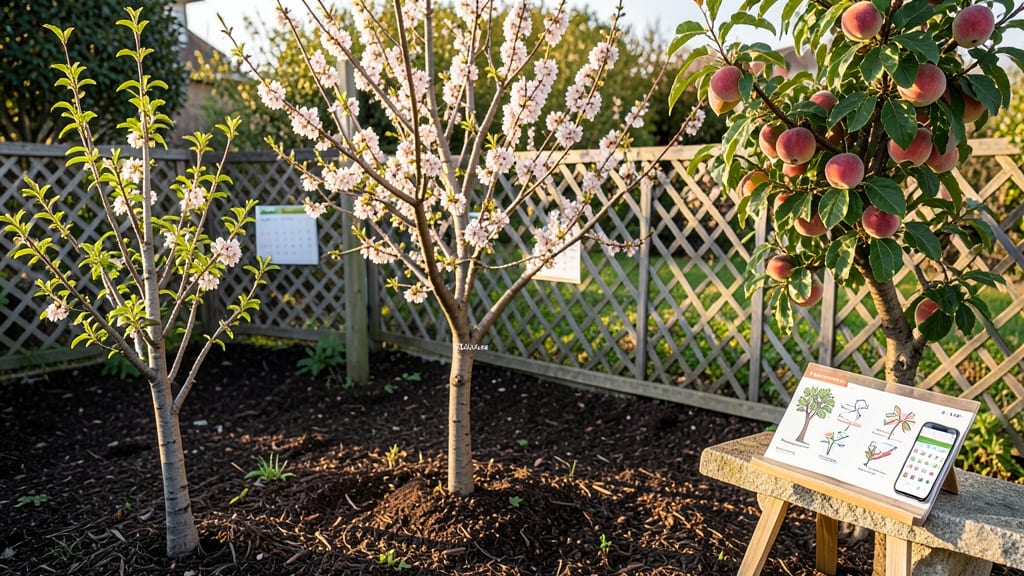
Peach trees typically begin bearing fruit within 2 to 5 years after planting, though this timeline varies significantly by variety, rootstock type, and growing conditions. Dwarf varieties often produce fruit as early as 2–3 years, while standard trees may take 4–5 years. Consistent care like proper pruning and sunlight exposure can help speed up fruiting.
This timeline isn't just about patience—it's about setting your tree up for success from day one. 🌱 The right rootstock (the part beneath the grafted peach variety) makes a huge difference: dwarf rootstocks force faster maturation, while standard rootstocks prioritize longevity.
I've seen Elberta varieties fruit in just 2 years with ideal care, while Redhaven trees sometimes need that extra year.
Climate plays a role too—trees in warmer zones may fruit sooner than those in colder regions, where they need more time to accumulate the necessary chilling hours (300–900 hours below 45°F) to trigger blooming.
What's fascinating is how pruning in the first two years shapes future fruit production. When you remove competing branches early, you're not just shaping the tree—you're directing its energy toward developing fruit-bearing wood.
I always recommend a 3-step pruning approach: first to establish structure, then to open the canopy for sunlight, and finally to remove water sprouts that drain energy. The payoff? Trees that start bearing fruit 1–2 years earlier than unpruned counterparts.
💡 In This Article
- Factors That Affect Peach Tree Fruit Production Timeline
- Pro Tips to Speed Up Peach Tree Fruit Bearing
Factors that affect peach tree fruit production timeline
The rootstock you choose is the single biggest factor in determining how quickly your peach tree will bear fruit. Dwarf rootstocks like Lovell or Halford force the tree to mature faster by restricting vertical growth, allowing energy to focus on fruit production.
These trees often bear fruit in just 2 years under ideal conditions. In contrast, standard rootstocks like Nemaguard prioritize longevity and disease resistance, which can delay fruiting until 4–5 years. The trade-off? Dwarf trees produce smaller yields but earlier, while standard trees offer larger harvests over decades.
Climate plays a critical role through a concept called chilling hours—the number of hours below 45°F a tree needs each winter to trigger blooming. Varieties like Elberta require 500–800 chilling hours, making them ideal for colder zones, while Redhaven needs only 300–500 hours, perfect for warmer regions.
Without sufficient chilling, buds remain dormant, and fruiting gets delayed. I've seen Reliance trees (a low-chill variety) produce fruit in 2–3 years in Florida, while the same variety struggles in Michigan without supplemental chilling techniques.
Soil quality and sunlight exposure create a perfect storm for early fruiting. Peach trees thrive in well-draining soil with a pH of 6.0–7.0—too acidic or alkaline, and nutrient uptake suffers, stalling growth.
Full sun (6–8 hours daily) is non-negotiable: trees in partial shade may take 1–2 extra years to fruit. I once compared two J.H. Hale trees side by side—one in full sun bore fruit in 3 years, while the shaded counterpart took 5 years. The difference?
Sunlight drives photosynthesis, which fuels flower and fruit development.
Variety selection is the final piece of the puzzle. Early-bearing varieties like Redtop or Contender are bred to fruit in 2 years, while late-bearing varieties like Suncrest prioritize disease resistance over speed.
Even within the same variety, graft compatibility matters: a poorly grafted tree may take 1–2 extra years to establish. The graft union (where the scion meets rootstock) must heal perfectly—otherwise, the tree diverts energy to repairing itself instead of producing fruit.
Don't overlook the role of cross-pollination in fruit set. Many peach varieties are self-fruitful, but some (like Elberta) need a second tree within 50–100 feet for optimal pollination. Without it, flowers drop off, and fruiting gets delayed.
I've seen Redhaven trees produce 30% fewer fruits when planted alone versus paired with a J.H. Hale pollinator. Nature's efficiency at work!
Here's what most gardeners miss: stress factors like drought or pest damage can reset a tree's fruiting timeline. A peach tree under stress may skip a year of flowering entirely, pushing back fruiting by 1–2 seasons.
That's why consistent watering (1–2 inches per week) and pest control (like monitoring for peach tree borers) are critical. A healthy tree in optimal conditions doesn't just fruit sooner—it produces consistently year after year.