
Container Gardens
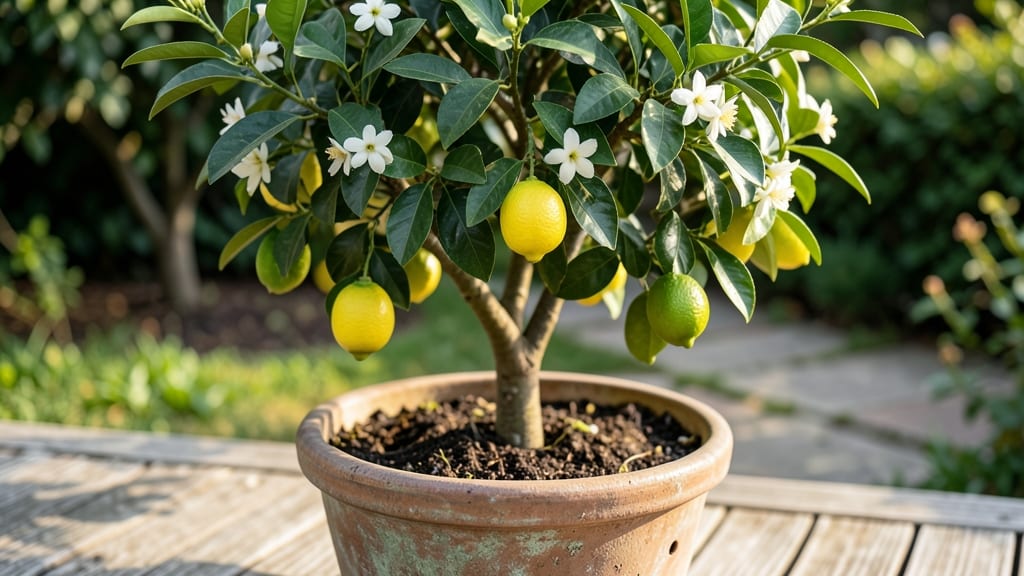
You can keep a lemon tree in a pot for years with proper care, but it must be repotted every 2-3 years as it grows. Opt for dwarf varieties, use containers with excellent drainage, and ensure it receives full sun (6+ hours daily) to maintain healthy growth and fruit production.
Lemon trees thrive in containers when given the right conditions, but their growth is directly tied to pot size and care routines. 🌱 Dwarf varieties like 'Meyer' or 'Improved Meyer' stay manageable in 15-20 gallon pots, while standard trees need larger containers to prevent root binding.
The key is balancing container dimensions with your tree's mature size—too small, and you'll stunt growth and fruit production.
Beyond pot selection, successful container lemon trees require specific maintenance. Use a well-draining potting mix with perlite or sand, and water only when the top inch of soil feels dry. During peak growing months (spring and summer), feed with citrus-specific fertilizer every 4-6 weeks.
Pruning in late winter promotes airflow and shapes the tree, while winterizing in colder climates protects tender varieties from frost damage.
💡 In This Article
- How Container Size Affects Lemon Tree Growth and Fruit Production
- Essential Pot Lemon Tree Care Tips for Long-Term Success
How container size affects lemon tree growth and fruit production
Container size directly impacts a lemon tree's root system development, which in turn affects nutrient uptake and fruit production. Roots need space to expand—when confined to small pots, they become root-bound, circling the container and competing for nutrients instead of growing outward.
This restriction reduces the tree's ability to absorb water and minerals efficiently, leading to stunted growth and smaller fruit yields.
For example, a 5-gallon pot might support a young tree for 1-2 years, but by year 3, roots will fill the space, forcing the tree to redirect energy toward survival rather than flowering or fruiting.
The depth of the container matters just as much as its diameter. Lemon trees develop a deep taproot system that can reach 2-3 feet in ideal conditions, but in containers, this growth is limited by pot height.
Shallow pots (12 inches deep) restrict root penetration, forcing roots to grow horizontally and increasing the risk of instability. A 20-gallon pot (18-24 inches deep) provides enough depth for dwarf varieties like 'Meyer' to develop a stable root structure while allowing room for seasonal growth.
The wider the pot's diameter, the more surface area roots have to access oxygen and water, which translates to healthier foliage and better fruit set.
Pot size also influences fruit production through a phenomenon called "container stress." When roots can't expand, the tree experiences mild water and nutrient deprivation, triggering a survival response that prioritizes root growth over fruit development. This is why dwarf varieties—bred to thrive in containers—produce fruit more reliably than standard trees.
For instance, a 15-gallon pot can support a 4-5 foot tall Meyer lemon tree, yielding 50-100 lemons annually, whereas the same tree in a 3-gallon pot might produce only 10-20 lemons due to root restriction.
The key is matching pot size to the tree's mature height: add 1-2 gallons of capacity per year of growth to prevent overcrowding.
Drainage holes are another critical factor tied to container size. Larger pots retain moisture longer, but without proper drainage, roots suffocate in soggy soil, leading to root rot—a silent killer of container-grown citrus.
A 20-gallon pot with 4-6 drainage holes (placed near the bottom) allows excess water to escape while maintaining soil moisture. For smaller pots (5 gallons), use 2-3 holes to balance drainage and water retention.
The rule of thumb: 1 drainage hole per 2 gallons of pot volume, with holes spaced evenly around the container's base to prevent water pooling in one area.
Seasonal adjustments further highlight the impact of container size. In summer, larger pots moderate temperature fluctuations better than small ones, protecting roots from heat stress. A 20-gallon pot can maintain 5-10°F cooler soil temperatures than a 5-gallon pot under direct sunlight, reducing the risk of heat shock.
Conversely, in winter, smaller pots cool down faster, making them vulnerable to frost damage in colder climates. This is why dwarf varieties in appropriately sized containers are more resilient to temperature swings—a critical advantage for container gardeners in variable climates.
To maximize fruit production, monitor root growth by gently lifting the pot every 6-12 months to check for circling roots. If roots encircle the pot's interior, it's time to repot into a container 2-4 inches larger in diameter.
This gradual upsizing mimics natural root expansion and signals the tree to focus on foliage and fruit rather than root survival. The payoff? A well-sized container can extend a lemon tree's productive life by 10-15 years or more, compared to just 3-5 years in an undersized pot.