
Trees
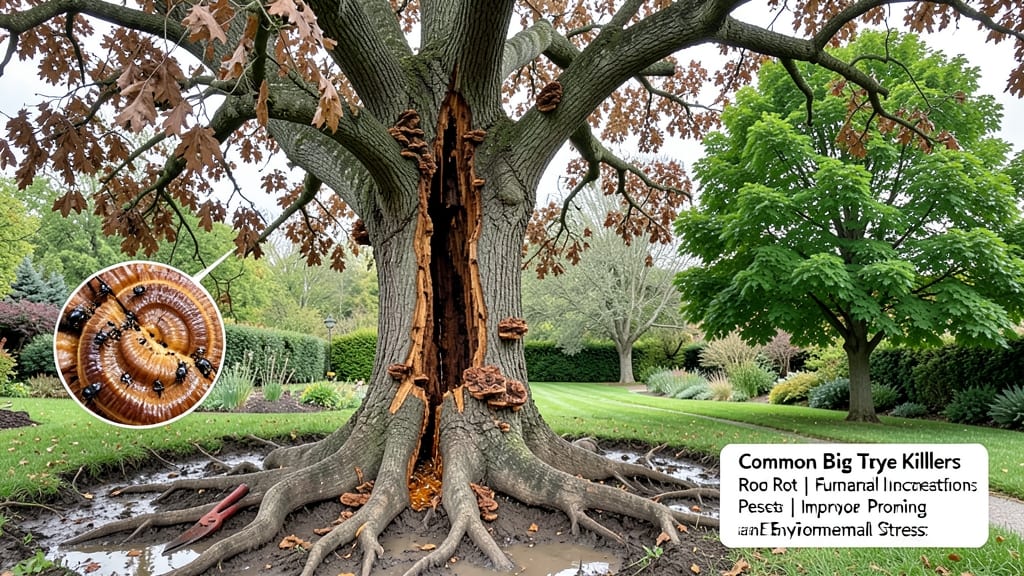
Big tree killer disease, caused by aggressive fungal pathogens like Phytophthora or Armillaria, systematically destroys root systems and vascular tissues, causing rapid wilting, leaf dieback, and tree death if left untreated. Immediate diagnosis and intervention are your best shot at saving the tree.
This destructive fungal infection doesn't just target weak trees—it can devastate even healthy mature specimens within months. 🌳 The pathogens thrive in moist soil, spreading through contaminated water or root contact, which is why early detection is everything.
I've seen cases where homeowners missed the subtle early signs—like yellowing leaves or oozing sap—and lost trees that could have been saved with proper treatment.
What makes this particularly insidious is how the fungus blocks water transport, causing sudden wilting even when soil moisture appears normal. The key difference from drought stress? Infected trees often show fungal growth at the base or mushrooms emerging from the roots—clear visual red flags that demand immediate action.
💡 In This Article
- Identifying Big Tree Killer Symptoms in Mature Trees
- Step-by-Step Treatment for Fungal Tree Diseases
Identifying big tree killer symptoms in mature trees
The fungal pathogens responsible for big tree killer disease—like Phytophthora cinnamomi or Armillaria species—attack trees through two primary pathways: root infection and vascular tissue invasion. These fungi produce enzymes that break down cell walls in roots, creating entry points for further colonization.
Once inside, they form a dense mycelial network that clogs xylem vessels, the tree's water transport system, similar to how a blocked artery cuts off blood flow in humans. This disruption causes the classic symptom of sudden wilting, even when soil moisture levels appear adequate.
One of the most telling early signs is foliar discoloration that starts in the upper canopy and progresses downward. Unlike drought stress, which causes uniform browning, fungal infections often produce irregular yellowing or browning between leaf veins—a pattern called "interveinal chlorosis."
You might also notice oozing sap from cracks in the bark, which can appear as sticky, dark resin. At the tree base, look for white, fan-shaped mushrooms (a hallmark of Armillaria) or shelflike fungal growth on roots and trunk, especially during damp conditions. These growths indicate active fungal reproduction.
The progression of symptoms follows a predictable pattern: initial leaf yellowing (2-4 weeks after infection), followed by branch dieback (4-8 weeks), and finally structural instability as the root system decays.
What sets this apart from nutrient deficiencies is the localized nature of symptoms—often affecting one side of the tree first—while drought stress typically impacts the entire canopy uniformly.
Another key difference is the time of year: fungal infections often flare up in spring or fall when soil moisture is high, whereas drought stress peaks in summer.
For accurate diagnosis, examine the root flare—the swollen area at the tree base where roots meet the trunk. Healthy roots should be firm and light tan, while infected roots appear soft, dark brown, or black with a foul odor.
Use a knife to make a small cut: healthy wood is light-colored and moist, while infected wood often shows dark streaks (vascular discoloration) or a spongy texture.
If you're unsure, collect a small root sample in a paper bag (not plastic) and take it to a local extension office for lab testing—this can confirm the pathogen type within 7-10 days.
Visual inspection alone isn't always sufficient, which is why understanding the environmental conditions matters. Big tree killer thrives in compacted, waterlogged soils with poor drainage, often found in urban landscapes where heavy foot traffic or construction has disrupted natural soil structure.
Trees planted in containers or those with girdling roots are particularly vulnerable because their root systems can't access deeper moisture reserves. Pay attention to nearby trees—fungal spores can travel up to 30 feet through soil or water, so clustered dieback among multiple trees is a strong indicator.
What most people overlook is the seasonal variation in symptom severity. During dry periods, infected trees may appear to recover temporarily as the fungus's growth slows, only to worsen when rains return. This "false recovery" can delay treatment until the disease has progressed too far.
To test for early infection, gently scratch the bark near the root flare—if you see white fungal threads (hyphae) or blackened tissue, that's a definitive sign of active infection requiring immediate intervention.
Remember: the earlier you catch these symptoms, the better your chances of saving the tree. Even a 20% reduction in leaf area can signal a 50% loss in photosynthetic capacity, accelerating decline. Regular monitoring—especially after heavy rains—can give you that critical head start. 🌟