
Size
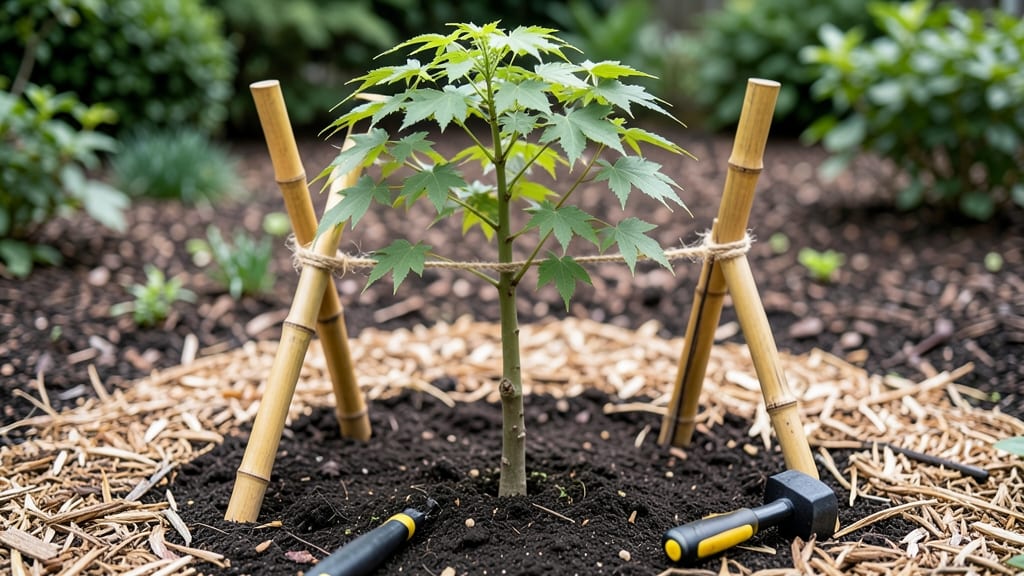
To stake a tree to grow straight, use a single firm stake positioned at a 45-degree angle 1/3 of the tree’s height from the base, securing it loosely with soft ties to allow trunk movement while preventing bending. Adjust as the tree grows to avoid girdling the bark.
Staking a tree at one-third its height creates the perfect balance between support and natural movement. 🌳 The 45-degree angle distributes wind pressure evenly, reducing stress on the roots while keeping the trunk upright. Using soft ties—like fabric strips—lets the tree sway slightly, which actually strengthens its stem over time.
I’ve found that most young trees only need staking for the first 1-2 years, after which they can stand independently if planted correctly.
One common mistake gardeners make is using stakes that are too thick or ties that cut into the bark as the tree grows. Always check your work every few months to ensure the ties aren’t digging in, as even slight damage can weaken the tree’s ability to heal.
For larger trees, you might need two stakes placed diagonally, but for most species, a single stake does the job beautifully.
💡 In This Article
- Optimal Tree Staking Height and Angle for Healthy Growth
- Step-by-Step Guide to Staking Young Trees Correctly
Optimal tree staking height and angle for healthy growth
The one-third height rule for tree staking isn't arbitrary—it's rooted in physics. When you place a stake at roughly 33% of the tree’s height, you create a mechanical advantage that mimics natural wind resistance patterns.
At this point, the tree’s center of gravity shifts just enough to stabilize the trunk without over-restricting movement. Think of it like a seesaw: placing the fulcrum at one-third the length creates the most balanced leverage, preventing top-heavy young trees from leaning excessively in storms.
The 45-degree angle is equally critical because it distributes wind forces diagonally rather than vertically. A vertical stake would force the tree to grow against it, creating stress points where the trunk meets the soil.
At 45 degrees, the stake acts like a guy wire, redirecting lateral forces through the ground while allowing the tree’s natural flexibility to develop.
For example, a 6-foot tree would need a stake placed about 2 feet from the base, angled outward to match the tree’s lean direction if present.
Loose ties are non-negotiable because trees grow—sometimes up to 1-2 inches per year in diameter. Ties that are too tight can girdle the bark, cutting off the tree’s circulation system (phloem) and causing permanent damage.
Fabric strips or wide nylon webbing stretch slightly as the trunk thickens, while rubber bands or wire can embed themselves into the bark. Always use ties that can be adjusted without tools, and check them every 4-6 weeks during the growing season.
Here’s what happens when you get the angle wrong: A stake placed too vertically (less than 30 degrees) creates a rigid lever that can snap under wind pressure, while one too horizontal (more than 60 degrees) offers little support.
The ideal 45-degree angle also prevents the stake from acting as a fulcrum that could cause the tree to pivot and uproot during high winds. For trees in exposed areas, consider adding a second stake on the opposite side to create a triangular support system.
Seasonal factors play a surprising role too. In winter, when trees are dormant, stakes can be tightened slightly to prevent snow load from bending young trunks. But during spring and summer growth spurts, always loosen ties to accommodate expansion.
The goal is to mimic the tree’s natural swaying motion—studies show that trees exposed to gentle movement develop 15-20% stronger stems than artificially rigid ones.
For larger species like oaks or maples, you might need two stakes placed diagonally to handle greater wind loads, but for most fruit trees or young shade trees, a single stake suffices.
The key is to match the stake’s diameter to the tree’s size: ½-inch stakes for small trees (3-6 feet) and ¾-inch stakes for larger specimens (6-10 feet). Always use untreated wood or metal stakes to prevent chemical leaching into the soil.
Remember: The best staking system is one the tree can eventually outgrow. Most species develop sufficient trunk strength after 1-2 years of proper staking, at which point the stakes should be removed to encourage natural stability. 🌱