
Watering
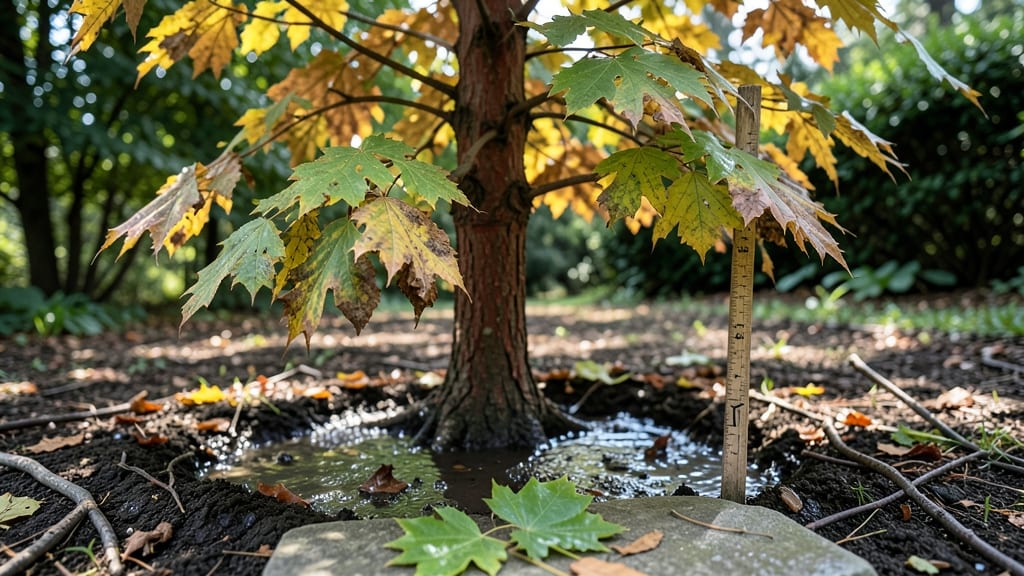
Your overwatered maple tree’s yellowing leaves aren’t just a seasonal change—they’re screaming for help, and it’s likely overwatering. 🌿 I’ve seen this mistake turn vibrant trees into sad, soggy shadows, but the fix is simpler than you’d think. The key is stopping the waterlogging that’s suffocating those roots.
First, check the soil: if it’s damp more than an inch below the surface, you’re overdoing it. Maple trees hate soggy feet—even in summer heat, they need well-drained soil. Grab a trowel and dig down; if water pools or the roots smell like wet socks, that’s your problem.
The good news? Healthy roots bounce back fast with the right care.
Within 2-3 weeks, you’ll see new green leaves pushing through if you cut back on watering and improve drainage. Mulch helps (but keep it 3-4 inches away from the trunk), and consider aerating compacted soil.
This isn’t just about saving leaves—it’s about giving your tree the breathing room it needs to thrive.
Pro tip: use a moisture meter or stick your finger in the soil before watering. If it’s dry at 2-3 inches deep, it’s time to water. Trust me, your maple will thank you with lush, green foliage by next season.
Root Causes Of Overwatered Maple Leaves
Overwatering isn’t just about too much water—it’s a cascade of environmental and biological factors that disrupt your maple tree’s delicate balance. Understanding these triggers helps you diagnose and fix the issue before it’s too late.
Let’s break down the science behind why your maple’s leaves turn yellow or wilt when they’re drowning in moisture.
Maple trees (Acer spp.) thrive in well-draining soil with a mix of sand, silt, and organic matter. When soil lacks proper aeration—often due to compacted clay or heavy loam—water pools around roots instead of draining away. This creates anaerobic (oxygen-deprived) conditions, forcing roots to suffocate.
- Why it happens:
- Clay-heavy soil repels water, forming a waterlogged "puddle" at the root zone.
- Organic buildup (like thick mulch or decomposed leaves) blocks airflow, trapping moisture.
- Improper planting depth buries roots too shallowly, exposing them to surface water.
- Actionable fix:
- Test your soil’s drainage by digging a hole, filling it with water, and timing how long it takes to drain. Ideal time: ≤ 2 hours.
- Amend soil with perlite, coarse sand, or compost to improve porosity.
- Avoid piling mulch against the trunk—keep it 3–4 inches away to prevent moisture traps.
Maples in humid climates or regions with frequent downpours (like the Pacific Northwest or Southeast U.S.) are especially vulnerable. While you can’t control the weather, how you respond makes all the difference.
- Why it happens:
- Natural rainfall + irrigation doubles water input, overwhelming root systems.
- Shallow root zones (common in young trees) can’t absorb excess water fast enough.
- Container-grown maples dry out quickly when repotted but then drown if overwatered post-planting.
- Actionable fix:
- Skip watering during heavy rain (check soil 2 inches deep—if damp, wait).
- Install French drains or swales to redirect surface water away from the base.
- For potted maples, ensure pots have drainage holes and elevate them on feet to prevent soggy bottoms.
Yellowing leaves aren’t always just water stress—pathogenic fungi thrive in perpetually damp conditions. Two common culprits target maples:
| Fungus | Symptoms | Why It Starts |
|---|---|---|
| Anthracnose | Dark spots, curled/yellow leaves | Spores splash from soil to leaves in wet weather. |
| Phytophthora | Root rot, wilting, leaf drop | Waterlogged soil spreads this soilborne pathogen. |
- Why it happens:
- Leaves stay wet for >48 hours, giving fungi time to infect.
- Poor air circulation (dense foliage or overcrowded plantings) traps humidity.
- Weakened roots from overwatering can’t fend off infections.
- Actionable fix:
- Prune to improve airflow—remove 1/3 of the canopy if branches are too dense.
- Apply copper fungicide (like Bonide Copper Fungicide) preventively before rainy seasons.
- Water at the base (avoid overhead sprinkling) to keep leaves dry.
Automatic sprinklers, drip lines, or even well-meaning gardeners can drown maples without realizing it. Maple roots are sensitive to consistent moisture—they need periods of dryness to develop resilience.
- Why it happens:
- Sprinklers wet foliage and soil, promoting fungal growth.
- Drip irrigation left on too long saturates the root zone without drainage breaks.
- Newly planted maples often get overwatered during the "root establishment" phase (first 2 years), when roots need time to spread.
- Actionable fix:
- Switch to soaker hoses or deep watering (1–2 inches per week, including rain).
- Shut off automatics during forecasted rain—use a rain sensor for sprinklers.
- For young trees, water deeply but infrequently (every 7–10 days in dry climates).
Maples in hot, dry climates (like Arizona) or cool, wet climates (like the UK) face different overwatering risks. Temperature extremes mess with transpiration rates—how fast leaves release water vapor.
- Why it happens:
- High humidity slows evaporation, so roots stay soggy longer.
- Cold soil (below 50°F) reduces root activity, making trees unable to absorb excess water.
- Sudden heatwaves after rain cause roots to "bake" in compacted, waterlogged soil.
- Actionable fix:
- Mulch properly: Use 3–4 inches of wood chips to regulate soil temp and retain moderate moisture.
- Adjust watering seasons: Reduce frequency in summer (when heat increases evaporation) and winter (when roots slow down).
- Aerate compacted soil in spring with a garden fork to improve drainage before summer rains hit.
Reviving Your Maple Tree in 3 Steps
Overwatered maple tree leaves can feel like a hopeless case, but with the right approach, you can nurse your tree back to health—no green thumb required! The key is to act fast, adjust your watering habits, and give your tree the space it needs to breathe.
Below, we’ll break down the most common causes of overwatering and the practical fixes to turn those sad, yellowing leaves into vibrant green once more.
If your maple tree’s leaves are wilting, yellowing, or falling off, the first rule is to halt the watering until the soil dries out. Overwatering suffocates roots by cutting off oxygen, leading to root rot—a silent killer for trees.
How to Fix It:
- 🔥 Pause Watering Completely
- Stop adding water for at least 3–5 days to let excess moisture evaporate. If the soil is soggy (like a damp sponge), wait even longer.
- 👨🍳 Check Soil Moisture Like a Pro - Stick your finger 2–3 inches deep into the soil. If it’s damp, hold off. If it’s bone-dry, you may have overcorrected—water lightly only if the top inch is dry. - Pro Tip: Use a moisture meter ($10–$15) for accuracy.
Aim for 40–60% moisture—not dripping wet.
- 🌡️ Improve Drainage Fast - If your tree is in a container, ensure it has drainage holes (no excuses!). If not, transfer it to a pot with holes ASAP. - For ground-planted trees, consider amending the soil with perlite, sand, or compost to boost drainage.
Mix in 1 part perlite to 3 parts native soil around the root zone.
Compacted or waterlogged soil strangles roots, preventing them from absorbing nutrients and oxygen. Loosening the soil around the base of your maple tree can revive it in weeks.
How to Fix It:
- ⏰ Best Time to Dig: Early Morning or Evening
- Avoid midday heat—roots are sensitive! Gently loosen the top 4–6 inches of soil around the drip line (the edge of the tree’s canopy).
- 🔪 Use the Right Tools
- A hand trowel or garden fork works best. Avoid heavy machinery—you don’t want to damage roots!
- Pro Tip: If the soil is rock-hard, soak it first with water, then loosen it in sections.
- ✨ Add Organic Matter for Long-Term Health
- Mix in 2–3 inches of compost or well-rotted manure to improve soil structure. This helps retain moisture without drowning roots and adds nutrients.
- Avoid fresh mulch near the trunk—keep it 3–4 inches away to prevent rot.
Now that your tree is on the mend, smart watering is your best friend. Maple trees hate soggy feet but also can’t handle drought stress—balance is key!
How to Fix It: 1. 📊 Water Deeply, Not Often
- Deep watering (1–2 inches per week, including rain) encourages roots to grow downward, making them more resilient.
- How to measure: Use a rain gauge or a tuna can buried in the soil.
Fill it with water to check depth.
- 🌡️ Water in the Morning (Never at Night!)
- Morning watering (before 10 AM) gives leaves time to dry, reducing fungal risks like powdery mildew.
- Avoid overhead sprinklers—they waste water and can spread disease. Use a soaker hose or drip irrigation instead.
- 🎯 Monitor Leaf Color for Clues
- Yellow leaves with brown edges? → Too much water or salt buildup (flush soil with rainwater).
- Wilting but still green? → Root-bound or thirsty (water deeply, then check roots).
- Curling leaves? → Possible fungal issue (reduce water, improve airflow).
Once your tree is back in shape, lock in those gains with these long-term strategies:
- ✅ Mulch Right: Apply 2–3 inches of mulch (wood chips or bark) away from the trunk to retain moisture and regulate temperature. - ✅ Prune Wisely: Remove dead or crowded branches in late winter to improve airflow. Never prune during wet seasons—it invites disease. - ✅ Test Your Soil: Every 2–3 years, get a soil test ($15–$20) to check pH and nutrient levels.
Maple trees prefer slightly acidic to neutral soil (6.0–7.0 pH). - ✅ Choose the Right Pot (If Container-Grown): Ensure it’s at least 12–18 inches deeper than the root ball and 20% wider for stability.
Final Thought: Overwatered maple leaves don’t mean game over—they mean your tree is crying out for better care. By draining excess water, aerating roots, and watering smarter, you’ll see new growth in as little as 4–6 weeks.
Stick with it, and your maple will reward you with lush, vibrant foliage for years! 🌳💚
Frequently asked questions
How can I tell if my maple tree is overwatered vs. underwatered?
Check the leaves and soil: overwatered maples show yellowing leaves (often starting at the bottom), soggy soil that smells musty, and possible fungal growth. Underwatered trees have crispy, brown edges and dry soil that pulls away from roots. Stick your finger 2-3 inches deep—if damp, it's overwatered; if bone dry, it's thirsty.
Will pruning help my overwatered maple tree recover faster?
Yes! Prune 1/3 of the canopy to improve airflow and reduce fungal risks. Focus on removing yellow or diseased leaves and any crowded branches. Do this in late winter when the tree is dormant, and avoid pruning during wet seasons to prevent infections.
How long does it take to see improvement after fixing overwatering?
You should notice new green growth in 4-6 weeks if you've stopped overwatering and improved drainage. For severe cases, it may take 2-3 months as roots recover. Monitor leaf color—bright green means progress, while new yellowing suggests you're still overwatering.
Can I use coffee grounds or other household waste in the soil to help?
Use coffee grounds sparingly—they're acidic and can harm maples if overused. Instead, mix in compost or well-rotted manure to improve soil structure. Avoid fresh mulch near the trunk (keep it 3-4 inches away) to prevent rot and fungal growth.
What's the best way to water a maple tree in containers?
Use the soak-and-dry method: Water until it drains from the bottom, then wait until the top 1 inch is dry before watering again. Always use pots with drainage holes and elevate them on feet to prevent soggy bottoms. In summer, water every 5-7 days; in winter, reduce to every 10-14 days.