
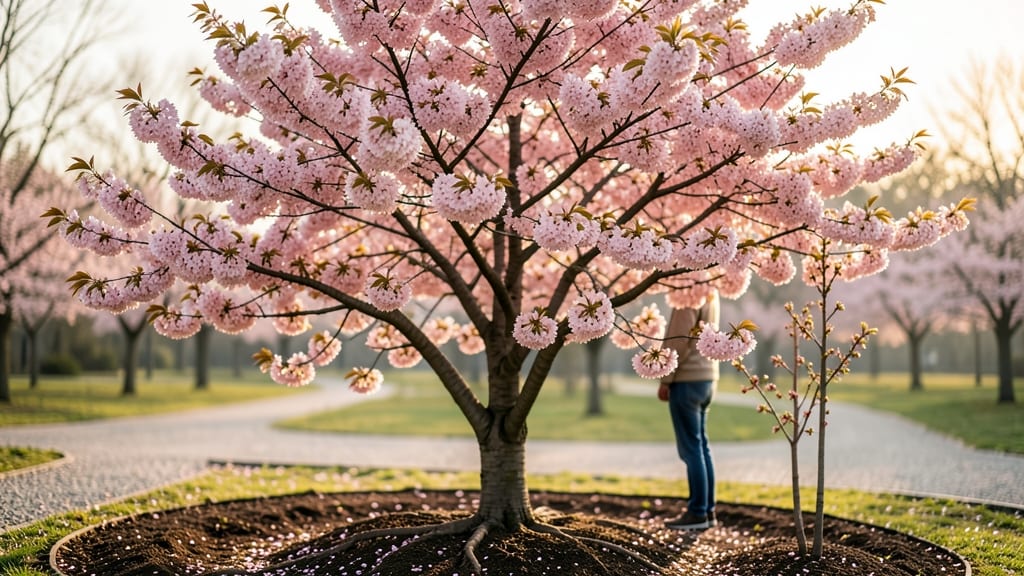
How Tall Do Cherry Blossom Trees Grow: Variety-Specific Heights Compared

How To

How Tall Do Cherry Blossom Trees Grow: Variety-Specific Heights Compared

How tall does a cherry blossom tree grow? At maturity, it reaches 20 to 40 feet, turning a small yard into a springtime showstopper with its delicate pink blooms 🌸.

Watching cherry blossoms burst into delicate pink clouds is magical—but before planting, knowing their mature height ensures your garden space matches their grand potential.

Some varieties, like the Yoshino cherry, can reach towering heights of 30 feet, while others, like the Kwanzan, stay slightly shorter at 25 feet. Dwarf varieties exist, but even those can still hit 15 to 25 feet, so spacing is key.

Below, I break down the height differences by variety, how fast they grow, and whether your space can handle their full, blossom-filled potential.

Dwarf
15-25 ft
Container friendly
Semi-Dwarf
25-35 ft
Most popular
Standard
30-40 ft
Full orchard size

Cherry blossom tree height by popular variety (with mature size guide)

Choosing the right cherry blossom tree for your garden starts with understanding their mature height. Some varieties grow tall enough to rival a two-story house, while others stay compact enough for small yards. Knowing these differences helps you plan spacing, pruning, and even neighborhood compatibility before planting.

Most cherry blossom trees belong to the Prunus genus, with Japanese cherry blossoms (Prunus serrulata) being the most popular. Their heights vary dramatically—from 15-foot dwarfs to 40-foot giants. Below, I’ve compared the most common varieties, including their growth rates and ideal spacing for healthy development.

Pro Tip: Always check your variety’s mature height against your property’s dimensions. A Weeping Cherry with 20-foot branches needs at least 15 feet of clearance above driveways or walkways to avoid future headaches.

Variety Mature Height Growth Rate Spacing Needs Best For
Yoshino Cherry (Prunus × yedoensis) 25–35 ft Moderate (1–2 ft/year) 15–20 ft from structures Large gardens, parks
Kwanzan Cherry (Prunus serrulata 'Kwanzan') 25–35 ft Moderate (1.5 ft/year) 20 ft from buildings Urban landscapes, statement trees
Weeping Cherry (Prunus serrulata 'Pendula') 15–25 ft (branches spread 15–20 ft) Slow (1 ft/year) 10 ft from structures Small yards, containers (dwarf varieties)
Autumn Brilliance® (Prunus × incam 'Autumn Brilliance') 20–25 ft Fast (2 ft/year) 15 ft from structures Small spaces, multi-season color
Shirotae (Prunus serrulata 'Shirotae') 30–40 ft Moderate (1.5 ft/year) 25 ft from buildings Large estates, park plantings
Mount Fuji (Prunus serrulata 'Mount Fuji') 20–30 ft Slow (0.5–1 ft/year) 12 ft from structures Small gardens, bonsai-style
Okame (Prunus × incam 'Okame') 20–25 ft Moderate (1–1.5 ft/year) 15 ft from structures Urban gardens, early blooms
Taihaku (Prunus serrulata 'Taihaku') 25–35 ft Moder

How to choose the right cherry blossom tree for your space

Selecting the perfect cherry blossom tree depends on your space and long-term vision. Standard varieties like Prunus serrulata can reach 30-40 feet, making them stunning centerpieces for large yards or parks. However, their towering height requires careful planning—especially in urban areas with limited space or power lines nearby.

If your garden is cozy or urban, dwarf varieties like Prunus 'Shirofugen' or Prunus 'Kiku-shidare-zakura' offer the same beauty at 15-25 feet. These compact options are perfect for patios, small courtyards, or even large containers, while still delivering breathtaking spring blooms.

The trade-off? They may need more frequent pruning to maintain their shape.

Cherry Blossom Tree Height Comparison

Standard Varieties
Height: 30-40 ft
Semi-Dwarf Varieties
Height: 25-35 ft
Dwarf Varieties
Height: 15-25 ft
Pros
- Grand statement piece
- Longer bloom season
- Ideal for large landscapes
Cons
- Needs more space
- Higher maintenance
- Risk of storm damage
Pros
- Fits smaller yards
- Lower pruning needs
- Urban-friendly
Cons
- Limited height
- May need container growing
- Less dramatic impact

Urban gardeners should also consider weeping cherry varieties like Prunus 'Pendula', which grow 20-30 feet tall but spread horizontally with graceful, cascading branches. This habit makes them ideal for narrow spaces or as focal points near walkways.

Just ensure you plant them at least 10 feet from structures to avoid root conflicts.

Pruning plays a critical role in managing height over time. Annual pruning in late winter (before buds swell) can reduce growth by 20-30% per year if needed. For example, if your 25-foot semi-dwarf starts encroaching on power lines, strategic pruning can keep it at 20 feet while maintaining its health.

Always use sterilized tools and remove no more than 25% of foliage in one session.

Rural properties offer more flexibility for full-size cherry blossoms, but even there, spacing matters. Plant trees 30-50 feet apart to prevent root competition and ensure each tree gets adequate sunlight.

In open fields, consider multiple dwarf varieties arranged in a naturalistic grouping—this creates a stunning "blossom meadow" effect while keeping individual heights manageable.

Before planting, check your local municipal tree codes—some areas regulate large tree species due to storm risks. For instance, Prunus serrulata may require permits in wind-prone regions.

When in doubt, consult a local arborist to assess your site’s wind exposure, soil drainage, and sunlight patterns before committing to a variety.

★★★★★4.9(8 reviews)
Categories How To